We may earn a commission when you buy through our links. Learn more
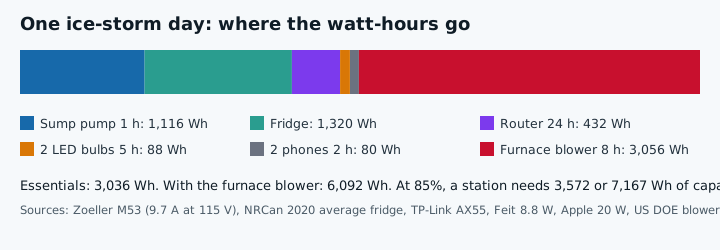
Count one day of your house first. Our typical essentials day is about 3,036 Wh; with a gas furnace blower running 8 hours, 6,092 Wh. At 85% efficiency, covering one essentials day takes a station of at least 3,572 Wh; the cheapest that did on November 14, 2026 with a published surge rating was the EcoFlow DELTA Pro at CA$1,999.
Days of backup per station
Stations of 1,500 Wh and more with at least 1,200 W continuous (enough for the sump pump while running), smallest first.
| Station | Price | Capacity | Days, essentials only [calc] | Days with the furnace blower 8 h [calc] | Continuous output |
|---|---|---|---|---|---|
| EcoFlow DELTA 3 1500 | CA$1,099 | 1,536 Wh | 0.4 | 0.2 | 1,800 W |
| Anker SOLIX S2000 | CA$849 | 2,010 Wh | 0.6 | 0.3 | 1,500 W |
| Jackery Explorer 2000 v2 | CA$1,099 | 2,042 Wh | 0.6 | 0.3 | 2,200 W |
| EcoFlow DELTA 3 Max | CA$989 | 2,048 Wh | 0.6 | 0.3 | 2,400 W |
| Anker SOLIX C2000 Gen 2 | CA$1,099 | 2,048 Wh | 0.6 | 0.3 | 2,400 W |
| EcoFlow DELTA 3 Max Plus | CA$1,299 | 2,048 Wh | 0.6 | 0.3 | 3,000 W |
| BLUETTI Elite 200 V2 | CA$1,079 | 2,074 Wh | 0.6 | 0.3 | 2,600 W |
| BLUETTI Apex 300 | CA$1,799 | 2,765 Wh | 0.8 | 0.4 | 3,840 W |
| BLUETTI Elite 300 | CA$1,699 | 3,014 Wh | 0.8 | 0.4 | 2,400 W |
| EcoFlow DELTA 3000 Gen4 | CA$1,599 | 3,072 Wh | 0.9 | 0.4 | 3,600 W |
| EcoFlow DELTA 3 Ultra | CA$1,599 | 3,072 Wh | 0.9 | 0.4 | 3,600 W |
| Anker SOLIX F3000 | CA$1,899 | 3,072 Wh | 0.9 | 0.4 | 3,600 W |
| EcoFlow DELTA 3 Ultra Plus | CA$1,999 | 3,072 Wh | 0.9 | 0.4 | 3,600 W |
| EcoFlow DELTA Pro | CA$1,999 | 3,600 Wh | 1.0 | 0.5 | 3,600 W |
| EcoFlow DELTA 3800 Gen4 | CA$2,499 | 3,763 Wh | 1.1 | 0.5 | 3,600 W |
| BLUETTI Elite 400 | CA$1,899 | 3,840 Wh | 1.1 | 0.5 | 2,600 W |
| Anker SOLIX F3800 Plus | CA$3,199 | 3,840 Wh | 1.1 | 0.5 | 6,000 W |
| EcoFlow DELTA Pro 3 | CA$2,799 | 4,096 Wh | 1.1 | 0.6 | 4,000 W |
| Jackery Explorer 5000 Plus | CA$3,899 | 5,040 Wh | 1.4 | 0.7 | 7,200 W |
Making it last
- Run the big loads in turns: the fridge holds its cold for a while with the door shut; the pump only needs power when water comes in.
- Recharge when you can: from solar on a mild day (within the 0°C charging limit), or from a generator outdoors, 6 metres from the house.
- Add an expansion battery from the same brand rather than a second station, when the model supports one.
Fuel generators stay outside. Health Canada: "Do not use a fuel burning generator indoors or in your garage or shed" and "Operate it at least 6 metres (20 feet) from buildings and direct the exhaust away from open windows and doors". An automatic CO shut-off "does not replace the need for carbon monoxide alarms in your home" (Health Canada, Carbon monoxide: Preventing exposure). A battery power station has no exhaust and can sit indoors; follow its manual for ventilation and placement.
Your own list, your own outage length: What will it run, and for how long. All models: power station comparison for Canada.
Frequently asked questions
How many kWh does a house need in an outage?
Our essentials day (sump pump 1 hour, average fridge, router, two LED bulbs, two phones) is about 3,036 Wh. Add a gas furnace blower running 8 hours and it is about 6,092 Wh. Your own list may be very different: use the calculator.
Is a 2,000 Wh power station enough for an ice storm?
For the essentials, about half a day at 85% [calc]: 1,741 usable Wh against 3,036 Wh a day. For a day or more, look at 3,600 Wh and up, run the pump and fridge in turns, or recharge.
How long did past Canadian ice storms cut power?
Long enough to plan in days, not hours. We do not quote outage durations here; check your utility's outage history for your area.