We may earn a commission when you buy through our links. Learn more
Contents
An average new fridge in Canada uses about 1,320 Wh a day (NRCan, 2020). A 1,024 Wh station gives about 870 Wh at 85% efficiency: roughly 16 hours. A 2,048 Wh station: about 32 hours. Add a freezer (807 Wh a day) and those numbers drop by about 40% [calc].
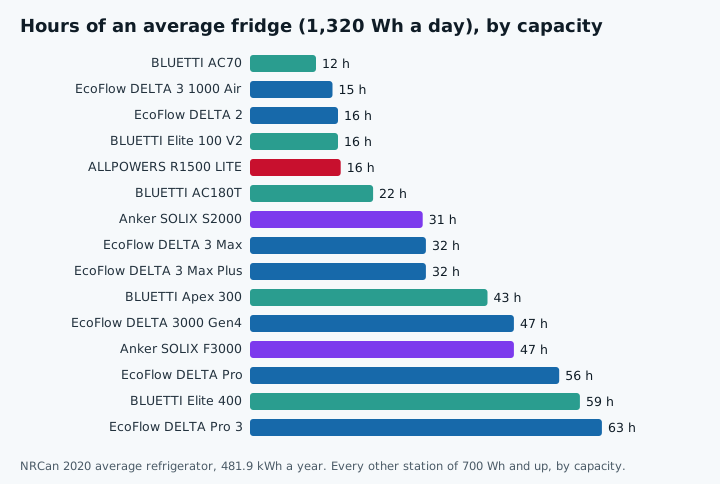
Hours of fridge, and fridge plus freezer
| Station | Price | Usable Wh at 85% [calc] | Fridge alone [calc] | Fridge + freezer [calc] | Continuous output |
|---|---|---|---|---|---|
| BLUETTI AC70 | CA$449 | 653 | 12 h | 7 h | 1,000 W |
| EcoFlow RIVER 2 Pro | CA$499 | 653 | 12 h | 7 h | 800 W |
| EcoFlow DELTA 3 1000 Air | CA$499 | 816 | 15 h | 9 h | 500 W |
| BLUETTI Elite 100 Mini | CA$549 | 853 | 16 h | 10 h | 700 W |
| EcoFlow DELTA 2 | CA$599 | 870 | 16 h | 10 h | 1,800 W |
| Anker SOLIX C1000 Gen 2 | CA$649 | 870 | 16 h | 10 h | 2,000 W |
| BLUETTI Elite 100 V2 | CA$649 | 870 | 16 h | 10 h | 1,800 W |
| EcoFlow DELTA 3 Classic | CA$699 | 870 | 16 h | 10 h | 1,800 W |
| ALLPOWERS R1500 LITE | CA$374.90 | 898 | 16 h | 10 h | 1,600 W |
| Jackery Explorer 1000 v2 | CA$649 | 910 | 17 h | 10 h | 1,500 W |
| BLUETTI AC180T | CA$1,199 | 1,218 | 22 h | 14 h | 1,800 W |
| EcoFlow DELTA 3 1500 | CA$1,099 | 1,306 | 24 h | 15 h | 1,800 W |
| Anker SOLIX S2000 | CA$849 | 1,708 | 31 h | 19 h | 1,500 W |
| Jackery Explorer 2000 v2 | CA$1,099 | 1,736 | 32 h | 20 h | 2,200 W |
| EcoFlow DELTA 3 Max | CA$989 | 1,741 | 32 h | 20 h | 2,400 W |
| Anker SOLIX C2000 Gen 2 | CA$1,099 | 1,741 | 32 h | 20 h | 2,400 W |
| EcoFlow DELTA 3 Max Plus | CA$1,299 | 1,741 | 32 h | 20 h | 3,000 W |
| BLUETTI Elite 200 V2 | CA$1,079 | 1,763 | 32 h | 20 h | 2,600 W |
| BLUETTI Apex 300 | CA$1,799 | 2,350 | 43 h | 27 h | 3,840 W |
| BLUETTI Elite 300 | CA$1,699 | 2,562 | 47 h | 29 h | 2,400 W |
| EcoFlow DELTA 3000 Gen4 | CA$1,599 | 2,611 | 47 h | 29 h | 3,600 W |
| EcoFlow DELTA 3 Ultra | CA$1,599 | 2,611 | 47 h | 29 h | 3,600 W |
| Anker SOLIX F3000 | CA$1,899 | 2,611 | 47 h | 29 h | 3,600 W |
| EcoFlow DELTA 3 Ultra Plus | CA$1,999 | 2,611 | 47 h | 29 h | 3,600 W |
| EcoFlow DELTA Pro | CA$1,999 | 3,060 | 56 h | 35 h | 3,600 W |
| EcoFlow DELTA 3800 Gen4 | CA$2,499 | 3,199 | 58 h | 36 h | 3,600 W |
| BLUETTI Elite 400 | CA$1,899 | 3,264 | 59 h | 37 h | 2,600 W |
| Anker SOLIX F3800 Plus | CA$3,199 | 3,264 | 59 h | 37 h | 6,000 W |
| EcoFlow DELTA Pro 3 | CA$2,799 | 3,482 | 63 h | 39 h | 4,000 W |
| Jackery Explorer 5000 Plus | CA$3,899 | 4,284 | 78 h | 48 h | 7,200 W |
Use your own fridge's number
- Find the kWh per year on its EnerGuide label (or the NRCan searchable product list) and divide by 365 for watt-hours a day.
- The running and starting watts of the compressor are on the rating plate, not in the NRCan figures. Enter the running watts in What will it run, and for how long to include the fridge in the output check.
- An older fridge uses more: NRCan's 2000 average was 638.8 kWh a year, a third more than 2020's.
Prices and every station: power station comparison for Canada.
Frequently asked questions
How much energy does a fridge use in a day?
The average refrigerator shipped in Canada in 2020 uses 481.9 kWh a year according to Natural Resources Canada, about 1,320 Wh a day. A fridge from 2000 averaged 638.8 kWh a year. Your fridge's EnerGuide label gives its own figure: divide by 365.
Will a 300 W power station run a fridge?
Energy-wise only for a few hours (a 288 Wh unit gives about 245 Wh, some 4 hours of an average fridge). Power-wise, the compressor's running and starting watts must fit under the station's continuous and surge ratings: check the fridge's rating plate.
Should I unplug the fridge to save battery?
You can run it in turns: a closed fridge keeps its cold for a while. How long food stays safe is a food-safety question for Health Canada's guidance, not something we calculate here.